
|
Electronic circuits and components * Course Index * Introduction * About the Author * About this Course * Feedback * Course Navigation * How to use this Course * TINA * Locktronics Fundamentals * Introduction: Fundamentals * Units and Multiples * Electricity * Electronic Principles * Electrical Circuits * Alternating Current * Assessment: Fundamentals Passive Components * Introduction: Passive Components * Resistors * Capacitors * Inductors * Transformers * Batteries, Fuses, Lamps and Switches * Assessment: Passive Components Semiconductors * Introduction: Semiconductors * Diodes * Transistors * Logic Gates * Assessment: Semiconductors ## Multiple Choice Quiz: Semiconductors ## Written Questions: Semiconductors ## Assignment: Semiconductors Passive Circuits * Introduction: Passive Circuits * Series and Parallel Connections * Kirchoff's Laws * Potential and Current Dividers * Passive Time Variant Circuits * Assessment: Passive Circuits Active Circuits * Introduction: Active Circuits * Power Supply Circuits * Operational Amplifier Circuits * Transistor Amplifier Circuits * 555 Timer Circuits * Assessment: Active Circuits Parts Gallery * Introduction: Parts Gallery * Passive Component Images * Semiconductor Images * Other Images * Quizzes |
(:Summary:Contains the 'action' links (like Browse, Edit, History, etc.), placed at the top of the page, see site page actions:) (:comment This page can be somewhat complex to figure out the first time you see it. Its contents are documented at PmWiki.SitePageActions if you need help. :) * Print (:comment (:if group Site,SiteAdmin,Cookbook,Profiles,PmWiki*:) (:comment delete if and ifend to enable backlinks:) * %item rel=nofollow class=backlinks accesskey='$[ak_backlinks]'% [[{*$Name}?action=search&q=link={*$FullName} | $[Backlinks] ]] (:ifend:) :) * Login Multiple Choice Quiz: Semiconductors<^< Assessment: Semiconductors | Course Index | Written Questions: Semiconductors >^>(:nl:) >>frame round<< Question 1: Zener diodes exhibit: (a) an abrupt reverse breakdown >>id=example1 class=question margin=10px frame round<< Answer: A >><< >>frame round<< Question 2: In a semiconductor diode, the depletion region is removed when: (a) the diode is in its forward conducting state >>id=example2 class=question margin=10px frame round<< Answer: A >><< >>frame round<< Question 3: The following data refers to an experiment carried out on a Zener diode:
The Zener voltage will be between: (a) 1 V and 2 V >>id=example3 class=question margin=10px frame round<< Answer: B >><< >>frame round<< Question 4: Which one of the following is TRUE of a two-input OR gate? (a) a logic 1 output will be produced only when both inputs are at logic 1 >>id=example4 class=question margin=10px frame round<< Answer: C >><< >>frame round<< Question 5: 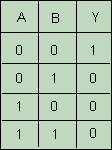 The truth table shown is for a two-input: (a) NAND gate >>id=example5 class=question margin=10px frame round<< Answer: B >><< >>frame round<< Question 6: The forward threshold voltage for a germanium diode is about: (a) 0.2 V >>id=example6 class=question margin=10px frame round<< Answer: A >><< >>frame round<< Question 7: 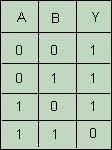 The truth table shown is for a two-input: (a) NAND gate >>id=example7 class=question margin=10px frame round<< Answer: A >><< >>frame round<< Question 8: The typical operating current for a light-emitting diode is approximately: (a) 1 to 5 mA >>id=example8 class=question margin=10px frame round<< Answer: B >><< >>frame round<< Question 9: Which one of the following Boolean expressions is correct for an exclusive-OR gate? (a) A + >>id=example9 class=question margin=10px frame round<< Answer: C >><< >>frame round<< Question 10: In normal (conducting) operation, the voltage that will appear between the base and emitter of an NPN bipolar junction transistor will be approximately: (a) 0.15 V >>id=example10 class=question margin=10px frame round<< Answer: C >><< >>frame round<< Question 11: The term 'covalent bonding' refers to: (a) the introduction of an impurity >>id=example11 class=question margin=10px frame round<< Answer: B >><< >>frame round<< Question 12: When a diode is in its non-conducting state it has: (a) a very low resistance >>id=example12 class=question margin=10px frame round<< Answer: B >><< >>frame round<< Question 13: The zone in a semiconductor diode where no free charge carriers exists is known as the: (a) anode region >>id=example13 class=question margin=10px frame round<< Answer: C >><< >>frame round<< Question 14: It is required to change a logic 0 state into a logic 1 state, and vice versa. The logic gate required to do this is known as: (a) a buffer >>id=example14 class=question margin=10px frame round<< Answer: B >><< >>frame round<< Question 15: The collector current in a bipolar junction transistor is 2 mA when the base current is 0.1 mA. Which one of the following gives the emitter current? (a) 1.9 mA >>id=example15 class=question margin=10px frame round<< Answer: B >><< >>frame round<< Question 16: The Boolean expression for the output of a two-input AND gate is: (a) A B >>id=example16 class=question margin=10px frame round<< Answer: B >><< >>frame round<< Question 17: In an NPN bipolar junction transistor the connections are arranged as follows: (a) base to P-type, emitter to N-type material, collector to N-type >>id=example17 class=question margin=10px frame round<< Answer: A >><< >>frame round<< Question 18: The collector current in a bipolar junction transistor is 2 mA when the base current is 0.1 mA. Which one of the following gives the value of common-emitter current gain? (a) 1.9 >>id=example18 class=question margin=10px frame round<< Answer: C >><< >>frame round<< Question 19: The forward threshold voltage for a silicon diode is about: (a) 0.15 V >>id=example19 class=question margin=10px frame round<< Answer: C >><< >>frame round<< Question 20: When a diode is in its conducting state: (a) current flows from anode to cathode >>id=example20 class=question margin=10px frame round<< Answer: A >><< >>frame round<< Question 21: In a metal-cased bipolar transistor, which of the three connections of the transistor are often connected directly to the conducting case? (a) base >>id=example21 class=question margin=10px frame round<< Answer: B >><< >>frame round<< Question 22: Which one of the following gives the relationship between the three currents flowing in a bipolar junction transistor? (a) I'_E_' = I'_B_' + I'_C_' >>id=example22 class=question margin=10px frame round<< Answer: A >><< >>frame round<< Question 23: How many electrons are present in the outer valence shell of a silicon atom? (a) 1 >>id=example23 class=question margin=10px frame round<< Answer: C >><< >>frame round<< Question 24: The three terminals of a bipolar junction transistor are known as: (a) source, gate, collector >>id=example24 class=question margin=10px frame round<< Answer: C >><< >>frame round<< Question 25: In its pure state, silicon has the properties of: (a) a conductor >>id=example25 class=question margin=10px frame round<< Answer: B >><< (:nl:)(:table style="clear:both":)
| |
(:Summary: Website page footer:)
Print - (:comment (:if group Site,SiteAdmin,Cookbook,Profiles,PmWiki*:) (:comment delete if and ifend to enable backlinks:) %item rel=nofollow class=backlinks accesskey='$[ak_backlinks]'% [[{*$Name}?action=search&q=link={*$FullName} | $[Backlinks] ]] (:ifend:) :) Search - Login
Page last modified on July 25, 2011, at 09:26 AM

