
|
Electronic circuits and components * Course Index * Introduction * About the Author * About this Course * Feedback * Course Navigation * How to use this Course * TINA * Locktronics Fundamentals * Introduction: Fundamentals * Units and Multiples * Electricity * Electronic Principles * Electrical Circuits * Alternating Current * Assessment: Fundamentals Passive Components * Introduction: Passive Components * Resistors * Capacitors ## Capacitor Specifications ## Preferred Values: Capacitors ## Capacitor Markings ## Examples: Capacitor Markings ## Capacitor Symbols ## Capacitor Construction ## Capacitors in Series ## Capacitors in Parallel ## Examples: Capacitors in Circuits ## Variable Capacitors * Inductors * Transformers * Batteries, Fuses, Lamps and Switches * Assessment: Passive Components Semiconductors * Introduction: Semiconductors * Diodes * Transistors * Logic Gates * Assessment: Semiconductors Passive Circuits * Introduction: Passive Circuits * Series and Parallel Connections * Kirchoff's Laws * Potential and Current Dividers * Passive Time Variant Circuits * Assessment: Passive Circuits Active Circuits * Introduction: Active Circuits * Power Supply Circuits * Operational Amplifier Circuits * Transistor Amplifier Circuits * 555 Timer Circuits * Assessment: Active Circuits Parts Gallery * Introduction: Parts Gallery * Passive Component Images * Semiconductor Images * Other Images * Quizzes |
(:Summary:Contains the 'action' links (like Browse, Edit, History, etc.), placed at the top of the page, see site page actions:) (:comment This page can be somewhat complex to figure out the first time you see it. Its contents are documented at PmWiki.SitePageActions if you need help. :) * Print (:comment (:if group Site,SiteAdmin,Cookbook,Profiles,PmWiki*:) (:comment delete if and ifend to enable backlinks:) * %item rel=nofollow class=backlinks accesskey='$[ak_backlinks]'% [[{*$Name}?action=search&q=link={*$FullName} | $[Backlinks] ]] (:ifend:) :) * Login Capacitor Markings<^< Preferred Values: Capacitors | Course Index | Examples: Capacitor Markings >^>(:nl:) 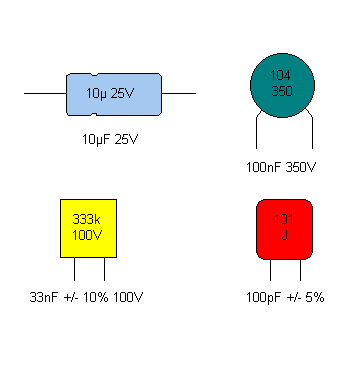 The vast majority of capacitors employ written markings which indicate their values, working voltages, and tolerance. The most usual method of marking resin dipped polyester, and other types of capacitor involves quoting the value (in μF, nF or pF), the tolerance (often either 10% or 20%), and the working voltage. Several manufacturers use two separate lines for their capacitor markings and these have the following meanings: First line: capacitance (in pF or μF) and tolerance (J=5%, K=10%, M=20%). Second line: rated d.c. voltage and code for the dielectric material. A three-digit code is often used to mark monolithic ceramic capacitors. The first two digits correspond to the first two digits of the value whilst the third digit is a multiplier which gives the number of zeros to be added to give the value in pF. Finally, it is essential to note that electrolytic capacitors (often those with larger values) require a d.c. polarizing current in order to operate correctly. Furthermore this voltage must be applied with the correct polarity. The terminals of electrolytic capacitors are therefore marked with symbols (often + and - ) to indicate the correct polarity - failure to obseve these markings when connecting a capacitor into a circuit can be catastrophic! (:nl:)(:table style="clear:both":)
| |
(:Summary: Website page footer:)
Print - (:comment (:if group Site,SiteAdmin,Cookbook,Profiles,PmWiki*:) (:comment delete if and ifend to enable backlinks:) %item rel=nofollow class=backlinks accesskey='$[ak_backlinks]'% [[{*$Name}?action=search&q=link={*$FullName} | $[Backlinks] ]] (:ifend:) :) Search - Login
Page last modified on July 21, 2011, at 02:51 PM