
|
Electronic circuits and components * Course Index * Introduction * About the Author * About this Course * Feedback * Course Navigation * How to use this Course * TINA * Locktronics Fundamentals * Introduction: Fundamentals * Units and Multiples * Electricity ## Conductors and Insulators ## Basic Circuit Symbols ## Voltage and Current ## Resistance ## Ohm's Law ## Worksheet: Ohm's Law ## Energy and Power ## Examples: Electricity * Electronic Principles * Electrical Circuits * Alternating Current * Assessment: Fundamentals Passive Components * Introduction: Passive Components * Resistors * Capacitors * Inductors * Transformers * Batteries, Fuses, Lamps and Switches * Assessment: Passive Components Semiconductors * Introduction: Semiconductors * Diodes * Transistors * Logic Gates * Assessment: Semiconductors Passive Circuits * Introduction: Passive Circuits * Series and Parallel Connections * Kirchoff's Laws * Potential and Current Dividers * Passive Time Variant Circuits * Assessment: Passive Circuits Active Circuits * Introduction: Active Circuits * Power Supply Circuits * Operational Amplifier Circuits * Transistor Amplifier Circuits * 555 Timer Circuits * Assessment: Active Circuits Parts Gallery * Introduction: Parts Gallery * Passive Component Images * Semiconductor Images * Other Images * Quizzes |
(:Summary:Contains the 'action' links (like Browse, Edit, History, etc.), placed at the top of the page, see site page actions:) (:comment This page can be somewhat complex to figure out the first time you see it. Its contents are documented at PmWiki.SitePageActions if you need help. :) * Print (:comment (:if group Site,SiteAdmin,Cookbook,Profiles,PmWiki*:) (:comment delete if and ifend to enable backlinks:) * %item rel=nofollow class=backlinks accesskey='$[ak_backlinks]'% [[{*$Name}?action=search&q=link={*$FullName} | $[Backlinks] ]] (:ifend:) :) * Login Conductors and Insulators<^< Electricity | Course Index | Basic Circuit Symbols >^>(:nl:) 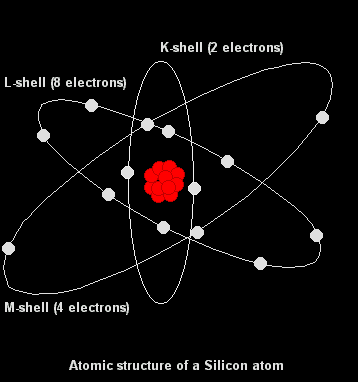 Electric current is the name given to the flow of electrons (or negative charge carriers). Electrons orbit around the nucleus of atoms just as the earth orbits around the sun. Electrons are held in one or more "shells", constrained to their orbital paths by virtue of a force of attraction towards the nucleus which contains an equal number of protons (positive charge carriers). Since like charges repel and unlike charges attract, negatively charged electrons are attracted to the positively charged nucleus. A similar principle can be demonstrated by observing the attraction between two permanent magnets; the two north poles of the magnets will repel each other, while a north and south pole will attract. In the same way, the unlike charges of the negative electron and the positive proton experience a force of mutual attraction. The outer shell electrons of a conductor can be easily interchanged between adjacent atoms within the lattice of atoms, from which the substance is composed. This makes it possible for the material to conduct electricity. Typical examples of conductors are metals such as copper, silver, iron, and aluminium. By contrast, the outer shell electrons of an insulator are firmly bound to their parent atoms and virtually no interchange of electrons is possible. Typical examples of insulators are plastics, rubber, and ceramic materials. (:nl:)(:table style="clear:both":)
| |
(:Summary: Website page footer:)
Print - (:comment (:if group Site,SiteAdmin,Cookbook,Profiles,PmWiki*:) (:comment delete if and ifend to enable backlinks:) %item rel=nofollow class=backlinks accesskey='$[ak_backlinks]'% [[{*$Name}?action=search&q=link={*$FullName} | $[Backlinks] ]] (:ifend:) :) Search - Login
Page last modified on August 01, 2011, at 08:21 AM