|
Electronic circuits and components * Course Index * Introduction * About the Author * About this Course * Feedback * Course Navigation * How to use this Course * TINA * Locktronics Fundamentals * Introduction: Fundamentals * Units and Multiples * Electricity * Electronic Principles * Electrical Circuits * Alternating Current * Assessment: Fundamentals Passive Components * Introduction: Passive Components * Resistors * Capacitors * Inductors * Transformers * Batteries, Fuses, Lamps and Switches * Assessment: Passive Components Semiconductors * Introduction: Semiconductors * Diodes * Transistors * Logic Gates * Assessment: Semiconductors Passive Circuits * Introduction: Passive Circuits * Series and Parallel Connections * Kirchoff's Laws * Potential and Current Dividers * Passive Time Variant Circuits * Assessment: Passive Circuits Active Circuits * Introduction: Active Circuits * Power Supply Circuits * Operational Amplifier Circuits * Transistor Amplifier Circuits * 555 Timer Circuits ## Introduction: 555 Timer ## Astable Pulse Generator ## Monostable Pulse Generator * Assessment: Active Circuits Parts Gallery * Introduction: Parts Gallery * Passive Component Images * Semiconductor Images * Other Images * Quizzes |
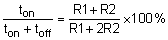
(:Summary:Contains the 'action' links (like Browse, Edit, History, etc.), placed at the top of the page, see site page actions:) (:comment This page can be somewhat complex to figure out the first time you see it. Its contents are documented at PmWiki.SitePageActions if you need help. :) * Print (:comment (:if group Site,SiteAdmin,Cookbook,Profiles,PmWiki*:) (:comment delete if and ifend to enable backlinks:) * %item rel=nofollow class=backlinks accesskey='$[ak_backlinks]'% [[{*$Name}?action=search&q=link={*$FullName} | $[Backlinks] ]] (:ifend:) :) * Login Astable Pulse Generator<^< Introduction: 555 Timer | Course Index | Monostable Pulse Generator >^>(:nl:) In order to understand how the astable pulse generator circuit operates, assume that the output (pin-3) is initially high and that the internal transistor, TR'_1_', is in the non-conducting state. The capacitor, C'_1_', will begin to charge with current supplied by means of series resistors, R'_1_' and R'_2_'. Note that the 3 internal resistors all have the same value. When the voltage at the threshold input (pin-6) exceeds two thirds of the supply voltage the output of the upper comparator will change state and the bistable will become reset due to voltage transition that appears at the R input of the RS latch. This, in turn, will make the The capacitor, C'_1_', will now discharge, with current flowing through R'_2_' into the collector of TR'_1_'. At a certain point, the voltage appearing at the trigger input (pin-2) will have fallen back to one third of the supply voltage at which point the lower comparator will change state and the voltage transition at S will return the bistable to its original set condition. The The output waveform produced by the circuit has the following properties: >>center<<Time for which output is high: t'_on_' = 0.693 (R'_1_' + R'_2_') C'_1_' Time for which output is low: t'_1_' = 0.693 R'_2_' C'_1_' Period of output waveform: t = t'_on_' + t'_off_' = 0.693 (R'_1_' + 2 R'_2_') C'_1_' Pulse repetition frequency: p.r.f. = Mark to space ratio: Duty cycle: Where t is in seconds, C'_1_' is in Farads, and R'_1_' and R'_2_' are in ohms. >><< Note that, because the high time (t'_on_') is always greater than the low time (t'_off_'), the mark to space ratio produced by a 555 timer can never be made equal to (or less than) unity. This could be a problem if we need to produce a precise square wave in which t'_on_' = t'_off_'. However, by making R'_2_' very much larger than R'_1_', the timer can be made to produce a reasonably symmetrical square wave output. (:nl:)(:table style="clear:both":)
| |
(:Summary: Website page footer:)
Print - (:comment (:if group Site,SiteAdmin,Cookbook,Profiles,PmWiki*:) (:comment delete if and ifend to enable backlinks:) %item rel=nofollow class=backlinks accesskey='$[ak_backlinks]'% [[{*$Name}?action=search&q=link={*$FullName} | $[Backlinks] ]] (:ifend:) :) Search - Login
Page last modified on August 15, 2011, at 03:07 PM
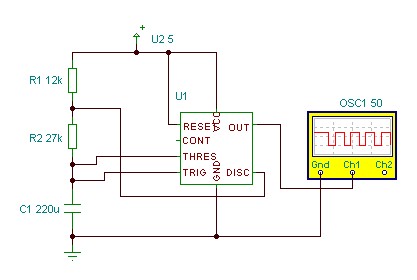
 output go high, turning TR'_1_' on at the same time. Due to the inverting action of the buffer on the output of