
|
Electronic circuits and components * Course Index * Introduction * About the Author * About this Course * Feedback * Course Navigation * How to use this Course * TINA * Locktronics Fundamentals * Introduction: Fundamentals * Units and Multiples * Electricity * Electronic Principles * Electrical Circuits * Alternating Current * Assessment: Fundamentals Passive Components * Introduction: Passive Components * Resistors * Capacitors * Inductors * Transformers * Batteries, Fuses, Lamps and Switches * Assessment: Passive Components ## Multiple Choice Quiz: Passive Components ## Written Questions: Passive Components ## Assignment: Passive Components Semiconductors * Introduction: Semiconductors * Diodes * Transistors * Logic Gates * Assessment: Semiconductors Passive Circuits * Introduction: Passive Circuits * Series and Parallel Connections * Kirchoff's Laws * Potential and Current Dividers * Passive Time Variant Circuits * Assessment: Passive Circuits Active Circuits * Introduction: Active Circuits * Power Supply Circuits * Operational Amplifier Circuits * Transistor Amplifier Circuits * 555 Timer Circuits * Assessment: Active Circuits Parts Gallery * Introduction: Parts Gallery * Passive Component Images * Semiconductor Images * Other Images * Quizzes |
(:Summary:Contains the 'action' links (like Browse, Edit, History, etc.), placed at the top of the page, see site page actions:) (:comment This page can be somewhat complex to figure out the first time you see it. Its contents are documented at PmWiki.SitePageActions if you need help. :) * Print (:comment (:if group Site,SiteAdmin,Cookbook,Profiles,PmWiki*:) (:comment delete if and ifend to enable backlinks:) * %item rel=nofollow class=backlinks accesskey='$[ak_backlinks]'% [[{*$Name}?action=search&q=link={*$FullName} | $[Backlinks] ]] (:ifend:) :) * Login Multiple Choice Quiz: Passive Components<^< Assessment: Passive Components | Course Index | Written Questions: Passive Components >^>(:nl:) >>frame round<< Question 1: The values available in the E6 series are: (a) 1.0, 1.5, 2.2, 3.3, 4.7, 6.8 >>id=example1 class=question margin=10px frame round<< Answer: A >><< >>frame round<< Question 2: The resistance of a light dependent resistor: (a) falls with increasing light level >>id=example2 class=question margin=10px frame round<< Answer: A >><< >>frame round<< Question 3: Two capacitors, each of 220 µF, are connected in parallel. The capacitance of the combination will be: (a) 110µF >>id=example3 class=question margin=10px frame round<< Answer: C >><< >>frame round<< Question 4: If the resistance of a material falls with increasing temperature it is said to have: (a) negative temperature coefficient >>id=example4 class=question margin=10px frame round<< Answer: A >><< >>frame round<< Question 5: The circuit symbol shown is a: 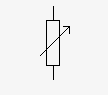 (a) fixed resistor >>id=example5 class=question margin=10px frame round<< Answer: C >><< >>frame round<< Question 6: Two capacitors, each of 15 µF, are connected in series. The capacitance of the combination will be: (a) 7.5µF >>id=example6 class=question margin=10px frame round<< Answer: A >><< >>frame round<< Question 7: The fourth band of a four band resistor is marked in silver. This indicates a tolerance of: (a) 5% >>id=example7 class=question margin=10px frame round<< Answer: B >><< >>frame round<< Question 8: The charge, Q, present in a capacitor is given by the relationship: (a) Q = C / V >>id=example8 class=question margin=10px frame round<< Answer: B >><< >>frame round<< Question 9: The primary and secondary voltages present in a loss-free transformer are 240 V and 12 V respectively. If the secondary is connected to a 6 Ω resistor, which one of the following gives the primary current? (a) 100 mA >>id=example9 class=question margin=10px frame round<< Answer: A >><< >>frame round<< Question 10: A graph of flux linkage, NΦ, plotted against current, I, for an inductor will take the form of: (a) a curve that rises rapidly >>id=example10 class=question margin=10px frame round<< Answer: C >><< >>frame round<< Question 11: The third band of a four band resistor is marked in black. This indicates a multiplier of: (a) 1 >>id=example11 class=question margin=10px frame round<< Answer: A >><< >>frame round<< Question 12: Two inductors, each of 6.8 mH, are connected in parallel. The inductance of the combination will be: (a) 3.4 mH >>id=example12 class=question margin=10px frame round<< Answer: A >><< >>frame round<< Question 13: A loss-free transformer has 1200 primary turns and 300 secondary turns. If the primary winding is connected to a 200 V AC supply which one of the following gives the secondary voltage: (a) 50 V >>id=example13 class=question margin=10px frame round<< Answer: A >><< >>frame round<< Question 14: A 100 nF capacitor has a tolerance of ±5%. The maximum possible value for this component will be: (a) 95 nF (b) 105 nF (c) 110 nF >><< >>id=example14 class=question margin=10px frame round<< Answer: B >><< >>frame round<< Question 15: Which one of the following statements is TRUE? (a) The windings in a transformer are linked by the voltage that is applied to the transformer's core >>id=example15 class=question margin=10px frame round<< Answer: C >><< >>frame round<< Question 16: The resistance of a light dependent resistor: (a) falls with increasing light level >>id=example16 class=question margin=10px frame round<< Answer: A >><< >>frame round<< Question 17: An inductor of 100 mH has a tolerance of ±20%. The maximum possible value for this component will be: (a) 80 mH >>id=example17 class=question margin=10px frame round<< Answer: C >><< >>frame round<< Question 18: Two resistors, each of 15 Ω, are connected in series. The resistance of the combination will be: (a) 7.5Ω >>id=example18 class=question margin=10px frame round<< Answer: C >><< >>frame round<< Question 19: A graph of charge, Q, plotted against voltage, V, for a capacitor will take the form of: (a) a curve that rises rapidly >>id=example19 class=question margin=10px frame round<< Answer: C >><< >>frame round<< Question 20: The third band of a four band resistor is marked in orange. This indicates a multiplier of: (a) 1,000 >>id=example20 class=question margin=10px frame round<< Answer: A >><< >>frame round<< Question 21: Two resistors, each of 220 Ω, are connected in parallel. The resistance of the combination will be: (a) 110Ω (b) 220Ω (c) 440Ω >><< >>id=example21 class=question margin=10px frame round<< Answer: A >><< >>frame round<< Question 22: What numeric value is indicated by a red band in the resistor colour code? (a) 1 >>id=example22 class=question margin=10px frame round<< Answer: B >><< >>frame round<< Question 23: A resistor is marked with the following coloured bands: Red, Red, Red, Gold The value of the resistor will be: (a) 222 Ω 5% >>id=example23 class=question margin=10px frame round<< Answer: B >><< >>frame round<< Question 24: In a loss-free transformer: (a) the primary and secondary powers will be the same >>id=example24 class=question margin=10px frame round<< Answer: A >><< >>frame round<< Question 25: Two inductors, each of 22 mH, are connected in series. The inductance of the combination will be: (a) 11 mH >>id=example25 class=question margin=10px frame round<< Answer: C >><< (:nl:)(:table style="clear:both":)
| |
(:Summary: Website page footer:)
Print - (:comment (:if group Site,SiteAdmin,Cookbook,Profiles,PmWiki*:) (:comment delete if and ifend to enable backlinks:) %item rel=nofollow class=backlinks accesskey='$[ak_backlinks]'% [[{*$Name}?action=search&q=link={*$FullName} | $[Backlinks] ]] (:ifend:) :) Search - Login
Page last modified on August 15, 2011, at 02:48 PM