|
Electronic circuits and components * Course Index * Introduction * About the Author * About this Course * Feedback * Course Navigation * How to use this Course * TINA * Locktronics Fundamentals * Introduction: Fundamentals * Units and Multiples * Electricity * Electronic Principles * Electrical Circuits * Alternating Current * Assessment: Fundamentals Passive Components * Introduction: Passive Components * Resistors * Capacitors * Inductors * Transformers * Batteries, Fuses, Lamps and Switches * Assessment: Passive Components Semiconductors * Introduction: Semiconductors * Diodes ## Operation ## Forward and Reverse Bias ## Diode Characteristics ## Worksheet: Diode Characteristics ## Zener Diodes ## Examples: Zener Diodes ## Worksheet: Zener Diodes ## Light Emitting Diodes * Transistors * Logic Gates * Assessment: Semiconductors Passive Circuits * Introduction: Passive Circuits * Series and Parallel Connections * Kirchoff's Laws * Potential and Current Dividers * Passive Time Variant Circuits * Assessment: Passive Circuits Active Circuits * Introduction: Active Circuits * Power Supply Circuits * Operational Amplifier Circuits * Transistor Amplifier Circuits * 555 Timer Circuits * Assessment: Active Circuits Parts Gallery * Introduction: Parts Gallery * Passive Component Images * Semiconductor Images * Other Images * Quizzes |
(:Summary:Contains the 'action' links (like Browse, Edit, History, etc.), placed at the top of the page, see site page actions:) (:comment This page can be somewhat complex to figure out the first time you see it. Its contents are documented at PmWiki.SitePageActions if you need help. :) * Print (:comment (:if group Site,SiteAdmin,Cookbook,Profiles,PmWiki*:) (:comment delete if and ifend to enable backlinks:) * %item rel=nofollow class=backlinks accesskey='$[ak_backlinks]'% [[{*$Name}?action=search&q=link={*$FullName} | $[Backlinks] ]] (:ifend:) :) * Login Diodes /
Forward and Reverse Bias<^< Operation | Course Index | Diode Characteristics >^>(:nl:)
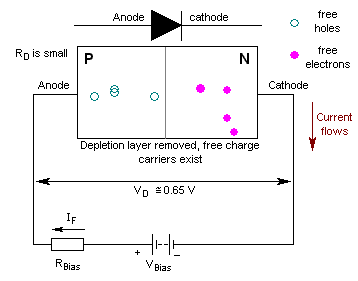
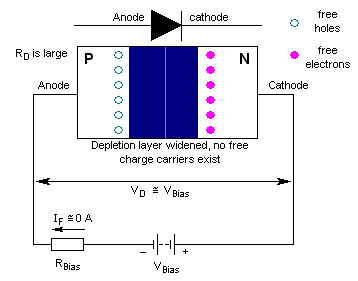
The connection to the P-type material is referred to as the anode whilst that to the N-type material is called the cathode. With no externally applied potential, electrons from the N-type material will cross into the P-type region and fill some of the vacant holes. This action will result in the production of a region either side of the junction in which there are no free charge carriers. This zone is known as the depletion region. If a positive voltage is applied to the P-type material, the free positive charge carriers will be repelled and they will move away from the positive potential towards the junction. Likewise, the negative potential applied to the N-type material will cause the free negative charge carriers to move away from the negative potential towards the junction. When the positive and negative charge carriers arrive at the junction, they will attract one another and combine (recall that unlike charges attract). As each negative and positive charge carrier combine at the junction, a new negative and positive charge carrier will be introduced to the semiconductor material from the voltage source. As these new charge carriers enter the semiconductor material, they will move toward the junction and combine. Thus, current flow is established and it will continue for as long as the voltage is applied. In the case of a reverse biased diode, the P-type material is negatively biased relative to the N-type material. In this case, the negative potential applied to the P-type material attracts the positive charge carriers, drawing them away from the junction. Likewise, the positive potential applied to the N-type material attracts the negative charge carriers away from the junction. This leaves the junction area depleted; virtually no charge carriers exist. Therefore, the junction area becomes an insulator, and current flow is inhibited. To summarize: In the forward-biased condition, when the anode is made positive with respect to the cathode, the diode freely passes current. In this state, the diode acts like a closed switch with a small voltage (0.65V approx.) dropped across it. In the reverse-biased condition, when the cathode is made positive with respect to the anode, the diode passes a negligible amount of current. In this state, the diode acts like an open switch with the (relatively large) applied voltage appearing across it. (:nl:)(:table style="clear:both":)
| |
(:Summary: Website page footer:)
Print - (:comment (:if group Site,SiteAdmin,Cookbook,Profiles,PmWiki*:) (:comment delete if and ifend to enable backlinks:) %item rel=nofollow class=backlinks accesskey='$[ak_backlinks]'% [[{*$Name}?action=search&q=link={*$FullName} | $[Backlinks] ]] (:ifend:) :) Search - Login
Page last modified on July 29, 2011, at 01:21 PM