
|
Electronic circuits and components * Course Index * Introduction * About the Author * About this Course * Feedback * Course Navigation * How to use this Course * TINA * Locktronics Fundamentals * Introduction: Fundamentals * Units and Multiples * Electricity * Electronic Principles * Electrical Circuits * Alternating Current * Assessment: Fundamentals Passive Components * Introduction: Passive Components * Resistors * Capacitors * Inductors * Transformers * Batteries, Fuses, Lamps and Switches * Assessment: Passive Components Semiconductors * Introduction: Semiconductors * Diodes ## Operation ## Forward and Reverse Bias ## Diode Characteristics ## Worksheet: Diode Characteristics ## Zener Diodes ## Examples: Zener Diodes ## Worksheet: Zener Diodes ## Light Emitting Diodes * Transistors * Logic Gates * Assessment: Semiconductors Passive Circuits * Introduction: Passive Circuits * Series and Parallel Connections * Kirchoff's Laws * Potential and Current Dividers * Passive Time Variant Circuits * Assessment: Passive Circuits Active Circuits * Introduction: Active Circuits * Power Supply Circuits * Operational Amplifier Circuits * Transistor Amplifier Circuits * 555 Timer Circuits * Assessment: Active Circuits Parts Gallery * Introduction: Parts Gallery * Passive Component Images * Semiconductor Images * Other Images * Quizzes |
(:Summary:Contains the 'action' links (like Browse, Edit, History, etc.), placed at the top of the page, see site page actions:) (:comment This page can be somewhat complex to figure out the first time you see it. Its contents are documented at PmWiki.SitePageActions if you need help. :) * Print (:comment (:if group Site,SiteAdmin,Cookbook,Profiles,PmWiki*:) (:comment delete if and ifend to enable backlinks:) * %item rel=nofollow class=backlinks accesskey='$[ak_backlinks]'% [[{*$Name}?action=search&q=link={*$FullName} | $[Backlinks] ]] (:ifend:) :) * Login Diodes /
Operation<^< Diodes | Course Index | Forward and Reverse Bias >^>(:nl:) 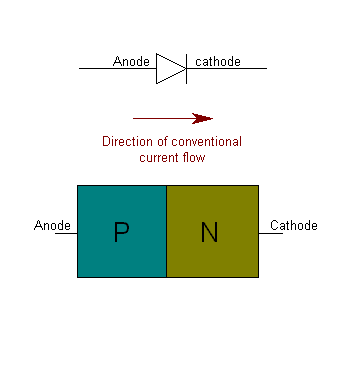 When a junction is formed between N-type and P-type semiconductor materials, the resulting device is called a diode. This component offers an extremely low resistance to current flow in one direction and an extremely high resistance to current flow in the other. This characteristic allows the diode to be used in applications that require a circuit to behave differently according to the direction of current flowing in it. An ideal diode would pass an infinite current in one direction and no current at all in the other direction. In addition, the diode would start to conduct current when the smallest of voltages was present. In practice, a small voltage must be applied before conduction takes place. Furthermore a small leakage current will flow in the reverse direction. This leakage current is usually a very small fraction of the current that flows in the forward direction. If the P-type semiconductor material is made positive relative to the N-type material by an amount greater than its forward threshold voltage (about 0.6V if the material is silicon and 0.2V if the material is germanium), the diode will freely pass current.If, on the other hand, the P-type material is made negative relative to the N-type material, virtually no current will flow unless the applied voltage exceeds the maximum (breakdown) voltage that the device can withstand. Note that a normal diode can be destroyed if its reverse breakdown voltage is exceeded. (:nl:)(:table style="clear:both":)
| |
(:Summary: Website page footer:)
Print - (:comment (:if group Site,SiteAdmin,Cookbook,Profiles,PmWiki*:) (:comment delete if and ifend to enable backlinks:) %item rel=nofollow class=backlinks accesskey='$[ak_backlinks]'% [[{*$Name}?action=search&q=link={*$FullName} | $[Backlinks] ]] (:ifend:) :) Search - Login
Page last modified on July 22, 2011, at 08:54 AM