|
Electronic circuits and components * Course Index * Introduction * About the Author * About this Course * Feedback * Course Navigation * How to use this Course * TINA * Locktronics Fundamentals * Introduction: Fundamentals * Units and Multiples * Electricity * Electronic Principles * Electrical Circuits * Alternating Current * Assessment: Fundamentals Passive Components * Introduction: Passive Components * Resistors * Capacitors * Inductors * Transformers * Batteries, Fuses, Lamps and Switches * Assessment: Passive Components Semiconductors * Introduction: Semiconductors * Diodes * Transistors * Logic Gates * Assessment: Semiconductors Passive Circuits * Introduction: Passive Circuits * Series and Parallel Connections * Kirchoff's Laws * Potential and Current Dividers * Passive Time Variant Circuits ## C-R Charging ## Worksheet: C-R Charging ## C-R Discharging ## Worksheet: C-R Discharging ## Passive Wave-shaping Circuits ## Worksheet: Passive Wave-shaping Circuits * Assessment: Passive Circuits Active Circuits * Introduction: Active Circuits * Power Supply Circuits * Operational Amplifier Circuits * Transistor Amplifier Circuits * 555 Timer Circuits * Assessment: Active Circuits Parts Gallery * Introduction: Parts Gallery * Passive Component Images * Semiconductor Images * Other Images * Quizzes |
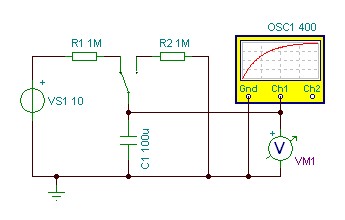
(:Summary:Contains the 'action' links (like Browse, Edit, History, etc.), placed at the top of the page, see site page actions:) (:comment This page can be somewhat complex to figure out the first time you see it. Its contents are documented at PmWiki.SitePageActions if you need help. :) * Print (:comment (:if group Site,SiteAdmin,Cookbook,Profiles,PmWiki*:) (:comment delete if and ifend to enable backlinks:) * %item rel=nofollow class=backlinks accesskey='$[ak_backlinks]'% [[{*$Name}?action=search&q=link={*$FullName} | $[Backlinks] ]] (:ifend:) :) * Login CR Charging<^< Passive Time Variant Circuits | Course Index | Worksheet: C-R Charging >^>(:nl:) Networks of capacitors and resistors (known as C-R circuits) form the basis of many timing, filter, and pulse shaping circuits. A simple C-R charging circuit is shown. When the circuit is connected to a constant voltage source (in this case a 100V battery) and the switch is closed, the voltage (V'_C_') across the (initially uncharged) capacitor will rise exponentially getting close, but never quite equal to 100V. At the same time, the current in the circuit (i'_C_') will fall exponentially. The rate of growth of voltage with time (and decay of current with time) will be dependent upon the product of capacitance and resistance. This value is known as the time constant of the circuit. Hence: time constant, t = C x R where C is the value of capacitance (in F), R is the resistance (in Ω), and t is the time constant (in s). For the circuit in the example: t = C x R = 10μF x 1MΩ = 10s It can be shown that the voltage developed across the charging capacitor (V'_c_') varies with time (t) according to the relationship: V'_c_' = V'_s_'(1 - e'^-t/CR^') where V'_c_' is the capacitor voltage, V'_s_', is the supply (battery) voltage, t is the time, and CR is the time constant of the circuit (equal to the product of capacitance, C, and resistance, R). The capacitor voltage will rise to approximately 63% of the supply voltage in a time interval equal to the time constant. At the end of the next interval of time equal to the time constant (i.e. after an elapsed time equal to 2CR) the voltage will have risen by 63% of the remainder, and so on. In theory, the capacitor will never become fully charged. However, after a period of time equal to 5C>R, the capacitor voltage will to all intents and purposes be equal to the supply voltage. At this point the capacitor voltage will have risen to 99.3% of its final value and we can consider it to be fully charged. During charging, the current in the capacitor (I'_C_') varies with time (t) according to the relationship: I'_C_' = (V'_S_'/R) e'^-t/CR^' where V'_S_', is the supply voltage, t is the time, C is the capacitance, and R is the resistance. The current will fall to approximately 37% of the initial current in a time equal to the time constant. At the end of the next interval of time equal to the time constant (i.e., after a total time of 2CR has elapsed) the current will have fallen by a further 37% of the remainder, and so on. (:nl:)(:table style="clear:both":)
| |
(:Summary: Website page footer:)
Print - (:comment (:if group Site,SiteAdmin,Cookbook,Profiles,PmWiki*:) (:comment delete if and ifend to enable backlinks:) %item rel=nofollow class=backlinks accesskey='$[ak_backlinks]'% [[{*$Name}?action=search&q=link={*$FullName} | $[Backlinks] ]] (:ifend:) :) Search - Login
Page last modified on July 29, 2011, at 10:01 AM