|
Electronic circuits and components * Course Index * Introduction * About the Author * About this Course * Feedback * Course Navigation * How to use this Course * TINA * Locktronics Fundamentals * Introduction: Fundamentals * Units and Multiples * Electricity * Electronic Principles * Electrical Circuits * Alternating Current ## Alternating Voltage and Current ## Waveforms and Signals ## Amplitude and Frequency ## Examples: Amplitude and Frequency ## Measuring Angles ## Radians ## Examples: Radians ## Average Peak and RMS Values ## Reactance ## Capacitive Reactance ## Worksheet: Capacitive Reactance ## Inductive Reactance ## Worksheet: Inductive Reactance ## Impedance ## Worksheet: Impedance * Assessment: Fundamentals Passive Components * Introduction: Passive Components * Resistors * Capacitors * Inductors * Transformers * Batteries, Fuses, Lamps and Switches * Assessment: Passive Components Semiconductors * Introduction: Semiconductors * Diodes * Transistors * Logic Gates * Assessment: Semiconductors Passive Circuits * Introduction: Passive Circuits * Series and Parallel Connections * Kirchoff's Laws * Potential and Current Dividers * Passive Time Variant Circuits * Assessment: Passive Circuits Active Circuits * Introduction: Active Circuits * Power Supply Circuits * Operational Amplifier Circuits * Transistor Amplifier Circuits * 555 Timer Circuits * Assessment: Active Circuits Parts Gallery * Introduction: Parts Gallery * Passive Component Images * Semiconductor Images * Other Images * Quizzes |
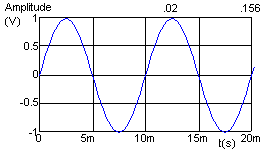
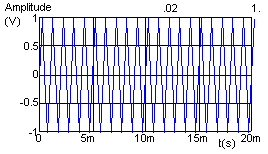
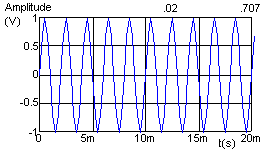
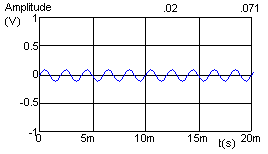
(:Summary:Contains the 'action' links (like Browse, Edit, History, etc.), placed at the top of the page, see site page actions:) (:comment This page can be somewhat complex to figure out the first time you see it. Its contents are documented at PmWiki.SitePageActions if you need help. :) * Print (:comment (:if group Site,SiteAdmin,Cookbook,Profiles,PmWiki*:) (:comment delete if and ifend to enable backlinks:) * %item rel=nofollow class=backlinks accesskey='$[ak_backlinks]'% [[{*$Name}?action=search&q=link={*$FullName} | $[Backlinks] ]] (:ifend:) :) * Login Amplitude and Frequency<^< Waveforms and Signals | Course Index | Examples: Amplitude and Frequency >^>(:nl:) The amplitude (or peak value) of a waveform is a measure of the extent of its voltage or current excursion from the resting value (usually zero). The peak-to-peak value for a wave which is symmetrical about its resting value is twice its peak value. The frequency of a repetitive waveform is the number of cycles of the waveform which occur in unit time. Frequency is expressed in Hertz (Hz). A frequency of 1Hz is equivalent to one cycle per second. Hence, if a voltage has a frequency of 400Hz, 400 cycles will occur in every second. The periodic time of a waveform is the time taken for one complete cycle of the wave. The relationship between periodic time and frequency is thus: t = 1/f or f = 1/t where t is the periodic time, in seconds and f is the frequency, in Hz. The equation for the sinusoidal voltage shown at a time, t, is: v = V'_max_' sin(ωt) where v is the instantaneous voltage, V'_max_' is the amplitude (or peak) voltage, and ω is the angular speed of the wave (in radians per second). Since one complete rotation of the wave (i.e. 360º) is equivalent to 2π radians we can deduce that: ω = 2πf where f is the frequency of the wave in Hertz. The images below allows you to see the relationship between waveform frequency, amplitude and the mathematical representation of the waveform.
| |
(:Summary: Website page footer:)
Print - (:comment (:if group Site,SiteAdmin,Cookbook,Profiles,PmWiki*:) (:comment delete if and ifend to enable backlinks:) %item rel=nofollow class=backlinks accesskey='$[ak_backlinks]'% [[{*$Name}?action=search&q=link={*$FullName} | $[Backlinks] ]] (:ifend:) :) Search - Login
Page last modified on August 01, 2011, at 10:00 AM