
|
Electronic circuits and components * Course Index * Introduction * About the Author * About this Course * Feedback * Course Navigation * How to use this Course * TINA * Locktronics Fundamentals * Introduction: Fundamentals * Units and Multiples * Electricity * Electronic Principles * Electrical Circuits * Alternating Current * Assessment: Fundamentals Passive Components * Introduction: Passive Components * Resistors * Capacitors * Inductors * Transformers * Batteries, Fuses, Lamps and Switches ## Batteries ## Examples: Batteries ## Internal Resistance ## Examples: Internal Resistance ## Fuses ## Lamps ## Switches ## Switch Types * Assessment: Passive Components Semiconductors * Introduction: Semiconductors * Diodes * Transistors * Logic Gates * Assessment: Semiconductors Passive Circuits * Introduction: Passive Circuits * Series and Parallel Connections * Kirchoff's Laws * Potential and Current Dividers * Passive Time Variant Circuits * Assessment: Passive Circuits Active Circuits * Introduction: Active Circuits * Power Supply Circuits * Operational Amplifier Circuits * Transistor Amplifier Circuits * 555 Timer Circuits * Assessment: Active Circuits Parts Gallery * Introduction: Parts Gallery * Passive Component Images * Semiconductor Images * Other Images * Quizzes |
(:Summary:Contains the 'action' links (like Browse, Edit, History, etc.), placed at the top of the page, see site page actions:) (:comment This page can be somewhat complex to figure out the first time you see it. Its contents are documented at PmWiki.SitePageActions if you need help. :) * Print (:comment (:if group Site,SiteAdmin,Cookbook,Profiles,PmWiki*:) (:comment delete if and ifend to enable backlinks:) * %item rel=nofollow class=backlinks accesskey='$[ak_backlinks]'% [[{*$Name}?action=search&q=link={*$FullName} | $[Backlinks] ]] (:ifend:) :) * Login Fuses<^< Examples: Internal Resistance | Course Index | Lamps >^>(:nl:) 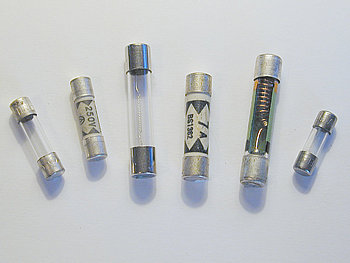 A fuse is simply an electrical conductor that is designed to fail when the current passing through it exceeds a certain threshold value. Most fuses comprise a thin wire conductor fixed inside a glass or ceramic tube and terminated at each end by caps which provide an effective electrical connection with the associated fuse-holder. The basic principle behind the fuse is simply that, by making the fuse the weakest link in the current path, it will fail before anything else does. This is, unfortunately sometimes NOT the case - simply because the action of rupturing (i.e., literally melting) even the thinnest of wire conductors takes a finite time. Other components can, and often do, fail much more rapidly. If a circuit is not fitted with a fuse, and a serious fault does arise, one or more other devices (often considerably more expensive) will usually fail. Various types of fuse and fusible device are fitted to modern electronic equipment. The main types are as follows: # Fuses designed for fitting into mains plugs (e.g. the 13A domestic plug universally found in the UK which may be fitted with 1A, 3A, 5A and 13A cartridge fuses). # 'Quick-blow' fuses (types F and FF). # 'Medium-blow' fuses (type M). # 'Slow-blow' (or 'time delay') fuses (types T and TT). # Electronic (or 'solid-state') resettable fuses. # Thermal fuses. (:nl:)(:table style="clear:both":)
| |
(:Summary: Website page footer:)
Print - (:comment (:if group Site,SiteAdmin,Cookbook,Profiles,PmWiki*:) (:comment delete if and ifend to enable backlinks:) %item rel=nofollow class=backlinks accesskey='$[ak_backlinks]'% [[{*$Name}?action=search&q=link={*$FullName} | $[Backlinks] ]] (:ifend:) :) Search - Login
Page last modified on July 21, 2011, at 02:57 PM