|
Electronic circuits and components * Course Index * Introduction * About the Author * About this Course * Feedback * Course Navigation * How to use this Course * TINA * Locktronics Fundamentals * Introduction: Fundamentals * Units and Multiples * Electricity * Electronic Principles * Electrical Circuits * Alternating Current * Assessment: Fundamentals Passive Components * Introduction: Passive Components * Resistors * Capacitors * Inductors * Transformers * Batteries, Fuses, Lamps and Switches ## Batteries ## Examples: Batteries ## Internal Resistance ## Examples: Internal Resistance ## Fuses ## Lamps ## Switches ## Switch Types * Assessment: Passive Components Semiconductors * Introduction: Semiconductors * Diodes * Transistors * Logic Gates * Assessment: Semiconductors Passive Circuits * Introduction: Passive Circuits * Series and Parallel Connections * Kirchoff's Laws * Potential and Current Dividers * Passive Time Variant Circuits * Assessment: Passive Circuits Active Circuits * Introduction: Active Circuits * Power Supply Circuits * Operational Amplifier Circuits * Transistor Amplifier Circuits * 555 Timer Circuits * Assessment: Active Circuits Parts Gallery * Introduction: Parts Gallery * Passive Component Images * Semiconductor Images * Other Images * Quizzes |
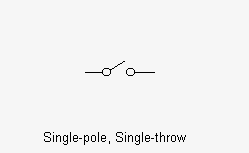
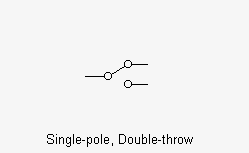
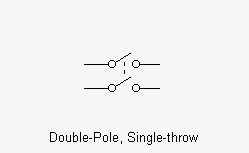
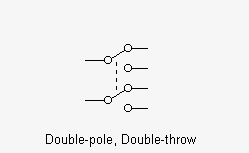
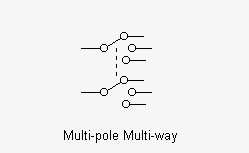
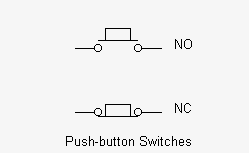
(:Summary:Contains the 'action' links (like Browse, Edit, History, etc.), placed at the top of the page, see site page actions:) (:comment This page can be somewhat complex to figure out the first time you see it. Its contents are documented at PmWiki.SitePageActions if you need help. :) * Print (:comment (:if group Site,SiteAdmin,Cookbook,Profiles,PmWiki*:) (:comment delete if and ifend to enable backlinks:) * %item rel=nofollow class=backlinks accesskey='$[ak_backlinks]'% [[{*$Name}?action=search&q=link={*$FullName} | $[Backlinks] ]] (:ifend:) :) * Login Switch Types<^< Switches | Course Index | Assessment: Passive Components >^>(:nl:) >>frame round<< The single-pole, single-throw (SPST) switch functions as a basic single-circuit 'on'/'off' switch. >>frame round<< The single-pole, double-throw (SPDT) switch functions as a single-circuit two-way switch. This type of switch is sometimes referred to as a single-pole changeover switch. >>frame round<< The double-pole, single-throw switch functions as a two-circuit 'on'/'off' switch. >>frame round<< The double-pole, double-throw switch functions as a two-circuit two-way switch. This type of switch is sometimes referred to as a double-pole changeover switch. >>frame round<< Complex circuits may require switches that can switch more than two ways or have more than two poles. These switches are called multi-pole, multi-way switches. Commonly available types include: * Two-pole, three-way (2P 3W) * Four-pole, two-way (4P 2W) * Three-pole, four-way (3P 4W) * Four-pole, three-way (4P 3W) * Two-pole, six-way (2P 6W) * One-pole, twelve-way (1P 12W) >>frame round<< Push-button switches (which may be either momentary or latching types) are available in normally open (NO) or normally closed (NC) types. The contacts of a normally open switch become closed when the switch is operated while those of a normally closed switch become opened when the switch is operated.
| |
(:Summary: Website page footer:)
Print - (:comment (:if group Site,SiteAdmin,Cookbook,Profiles,PmWiki*:) (:comment delete if and ifend to enable backlinks:) %item rel=nofollow class=backlinks accesskey='$[ak_backlinks]'% [[{*$Name}?action=search&q=link={*$FullName} | $[Backlinks] ]] (:ifend:) :) Search - Login
Page last modified on July 21, 2011, at 10:05 AM