
|
Electronic circuits and components * Course Index * Introduction * About the Author * About this Course * Feedback * Course Navigation * How to use this Course * TINA * Locktronics Fundamentals * Introduction: Fundamentals * Units and Multiples * Electricity * Electronic Principles * Electrical Circuits * Alternating Current * Assessment: Fundamentals Passive Components * Introduction: Passive Components * Resistors * Capacitors * Inductors * Transformers * Batteries, Fuses, Lamps and Switches ## Batteries ## Examples: Batteries ## Internal Resistance ## Examples: Internal Resistance ## Fuses ## Lamps ## Switches ## Switch Types * Assessment: Passive Components Semiconductors * Introduction: Semiconductors * Diodes * Transistors * Logic Gates * Assessment: Semiconductors Passive Circuits * Introduction: Passive Circuits * Series and Parallel Connections * Kirchoff's Laws * Potential and Current Dividers * Passive Time Variant Circuits * Assessment: Passive Circuits Active Circuits * Introduction: Active Circuits * Power Supply Circuits * Operational Amplifier Circuits * Transistor Amplifier Circuits * 555 Timer Circuits * Assessment: Active Circuits Parts Gallery * Introduction: Parts Gallery * Passive Component Images * Semiconductor Images * Other Images * Quizzes |
(:Summary:Contains the 'action' links (like Browse, Edit, History, etc.), placed at the top of the page, see site page actions:) (:comment This page can be somewhat complex to figure out the first time you see it. Its contents are documented at PmWiki.SitePageActions if you need help. :) * Print (:comment (:if group Site,SiteAdmin,Cookbook,Profiles,PmWiki*:) (:comment delete if and ifend to enable backlinks:) * %item rel=nofollow class=backlinks accesskey='$[ak_backlinks]'% [[{*$Name}?action=search&q=link={*$FullName} | $[Backlinks] ]] (:ifend:) :) * Login Lamps<^< Fuses | Course Index | Switches >^>(:nl:) 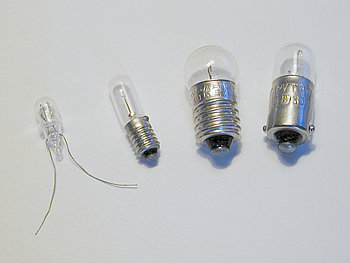 Lamps are used to provide illumination and also for signal indication in certain applications. Lamps consist of a fine tungsten wire filament housed inside an evacuated glass envelope. When an electric current passes through the wire filament, it will glow brightly but the filament will not 'burn out' (in normal use) simply because there is no atmosphere inside the glass envelope to support combustion. It is important to note that the 'hot' resistance of a lamp is very much higher than the 'cold' resistance of a lamp. The reason for this is simply that the material used for the filament has a positive temperature coefficient (PTC) and that the filament temperature, when glowing brightly, is well over 1,000°! Lamps are usually rated for a given voltage and current but they may also be rated in terms of power dissipation. Like resistors, lamps may be connected in series and parallel. For example, two 6 V lamps (each rated at 50 mA) can be connected in series across a 12 V, 100 mA supply. Alternatively, two 6 V lamps (each rated at 100 mA) may be connected in parallel across a 6 V, 200 mA supply. Finally, it is worth noting that filament lamps are not generally as reliable as light emitting diodes and for this reason they are rarely used in modern electronic equipment (:nl:)(:table style="clear:both":)
| |
(:Summary: Website page footer:)
Print - (:comment (:if group Site,SiteAdmin,Cookbook,Profiles,PmWiki*:) (:comment delete if and ifend to enable backlinks:) %item rel=nofollow class=backlinks accesskey='$[ak_backlinks]'% [[{*$Name}?action=search&q=link={*$FullName} | $[Backlinks] ]] (:ifend:) :) Search - Login
Page last modified on July 21, 2011, at 02:57 PM