|
Electronic circuits and components * Course Index * Introduction * About the Author * About this Course * Feedback * Course Navigation * How to use this Course * TINA * Locktronics Fundamentals * Introduction: Fundamentals * Units and Multiples * Electricity * Electronic Principles ## Electrostatics ## Electric Fields ## Capacitance ## Charge on a Capacitor ## Electric Field Strength ## Examples: Electric Field Strength ## The Unit of Capacitance ## Charge Capacitance and Voltage ## Energy Stored in a Capacitor ## Examples: Capacitance ## The Unit of Inductance ## Flux Linkage and Current ## Energy Stored in an Inductor ## Examples: Inductance ## Magnetism ## Electromagnetism ## Magnetic Fields ## Electromagnets ## Magnetic Field Strength ## Examples: Magnetism * Electrical Circuits * Alternating Current * Assessment: Fundamentals Passive Components * Introduction: Passive Components * Resistors * Capacitors * Inductors * Transformers * Batteries, Fuses, Lamps and Switches * Assessment: Passive Components Semiconductors * Introduction: Semiconductors * Diodes * Transistors * Logic Gates * Assessment: Semiconductors Passive Circuits * Introduction: Passive Circuits * Series and Parallel Connections * Kirchoff's Laws * Potential and Current Dividers * Passive Time Variant Circuits * Assessment: Passive Circuits Active Circuits * Introduction: Active Circuits * Power Supply Circuits * Operational Amplifier Circuits * Transistor Amplifier Circuits * 555 Timer Circuits * Assessment: Active Circuits Parts Gallery * Introduction: Parts Gallery * Passive Component Images * Semiconductor Images * Other Images * Quizzes |
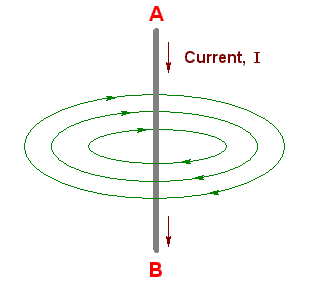
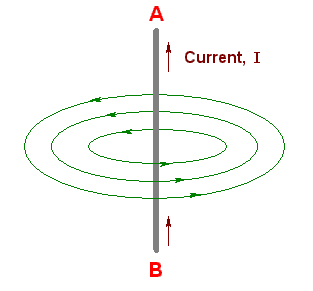
(:Summary:Contains the 'action' links (like Browse, Edit, History, etc.), placed at the top of the page, see site page actions:) (:comment This page can be somewhat complex to figure out the first time you see it. Its contents are documented at PmWiki.SitePageActions if you need help. :) * Print (:comment (:if group Site,SiteAdmin,Cookbook,Profiles,PmWiki*:) (:comment delete if and ifend to enable backlinks:) * %item rel=nofollow class=backlinks accesskey='$[ak_backlinks]'% [[{*$Name}?action=search&q=link={*$FullName} | $[Backlinks] ]] (:ifend:) :) * Login Electromagnetism<^< Magnetism | Course Index | Magnetic Fields >^>(:nl:) When a current flows through a conductor a magnetic field is produced in the vicinity of the conductor. The magnetic field is invisible but its presence can be detected using a compass needle (which will deflect from its normal north-south position). A magnetic field will be set up in the space surrounding a conductor that is carrying an electric current. The magnetic field lines define the direction in which a free north pole would move; the number of field lines in a particular region being used to indicate the relative strength of the field at the point in question. In the case of the field around a straight conductor, the lines of flux are concentric and the direction of the field can be determined by application of the Right-hand Screw Rule. The right hand screw rule will help you to remember the direction of the field. It works as follows: Think of a wood screw. To screw this into a plank of wood you have to screw to the right - it will then move into the wood. The direction of rotation is the same as the direction of the magnetic field. The direction of movement is the same as the direction of the current.
| |
(:Summary: Website page footer:)
Print - (:comment (:if group Site,SiteAdmin,Cookbook,Profiles,PmWiki*:) (:comment delete if and ifend to enable backlinks:) %item rel=nofollow class=backlinks accesskey='$[ak_backlinks]'% [[{*$Name}?action=search&q=link={*$FullName} | $[Backlinks] ]] (:ifend:) :) Search - Login
Page last modified on August 01, 2011, at 09:46 AM