
|
Electronic circuits and components * Course Index * Introduction * About the Author * About this Course * Feedback * Course Navigation * How to use this Course * TINA * Locktronics Fundamentals * Introduction: Fundamentals * Units and Multiples * Electricity * Electronic Principles ## Electrostatics ## Electric Fields ## Capacitance ## Charge on a Capacitor ## Electric Field Strength ## Examples: Electric Field Strength ## The Unit of Capacitance ## Charge Capacitance and Voltage ## Energy Stored in a Capacitor ## Examples: Capacitance ## The Unit of Inductance ## Flux Linkage and Current ## Energy Stored in an Inductor ## Examples: Inductance ## Magnetism ## Electromagnetism ## Magnetic Fields ## Electromagnets ## Magnetic Field Strength ## Examples: Magnetism * Electrical Circuits * Alternating Current * Assessment: Fundamentals Passive Components * Introduction: Passive Components * Resistors * Capacitors * Inductors * Transformers * Batteries, Fuses, Lamps and Switches * Assessment: Passive Components Semiconductors * Introduction: Semiconductors * Diodes * Transistors * Logic Gates * Assessment: Semiconductors Passive Circuits * Introduction: Passive Circuits * Series and Parallel Connections * Kirchoff's Laws * Potential and Current Dividers * Passive Time Variant Circuits * Assessment: Passive Circuits Active Circuits * Introduction: Active Circuits * Power Supply Circuits * Operational Amplifier Circuits * Transistor Amplifier Circuits * 555 Timer Circuits * Assessment: Active Circuits Parts Gallery * Introduction: Parts Gallery * Passive Component Images * Semiconductor Images * Other Images * Quizzes |
(:Summary:Contains the 'action' links (like Browse, Edit, History, etc.), placed at the top of the page, see site page actions:) (:comment This page can be somewhat complex to figure out the first time you see it. Its contents are documented at PmWiki.SitePageActions if you need help. :) * Print (:comment (:if group Site,SiteAdmin,Cookbook,Profiles,PmWiki*:) (:comment delete if and ifend to enable backlinks:) * %item rel=nofollow class=backlinks accesskey='$[ak_backlinks]'% [[{*$Name}?action=search&q=link={*$FullName} | $[Backlinks] ]] (:ifend:) :) * Login Magnetic Fields<^< Electromagnetism | Course Index | Electromagnets >^>(:nl:) 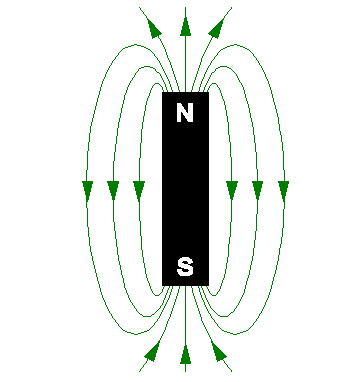 The force exerted on a free magnetic pole is a manifestation of the existence of a magnetic field. The magnetic field defines the direction and magnitude of the force experienced by a magnetic particle. The field itself is invisible to the human eye but can be drawn by constructing lines which indicate the motion of a free north pole within the field; the number of field lines in a particular region being used to indicate the relative strength of the field at the point in question. (:nl:)(:table style="clear:both":)
| |
(:Summary: Website page footer:)
Print - (:comment (:if group Site,SiteAdmin,Cookbook,Profiles,PmWiki*:) (:comment delete if and ifend to enable backlinks:) %item rel=nofollow class=backlinks accesskey='$[ak_backlinks]'% [[{*$Name}?action=search&q=link={*$FullName} | $[Backlinks] ]] (:ifend:) :) Search - Login
Page last modified on July 21, 2011, at 02:38 PM