
|
Electronic circuits and components * Course Index * Introduction * About the Author * About this Course * Feedback * Course Navigation * How to use this Course * TINA * Locktronics Fundamentals * Introduction: Fundamentals * Units and Multiples * Electricity * Electronic Principles * Electrical Circuits * Alternating Current * Assessment: Fundamentals Passive Components * Introduction: Passive Components * Resistors ## Resistor Specifications ## Examples: Resistor Specifications ## Preferred Values: Resistors ## Resistor Colour Code ## Examples: Resistor Colour Code Test ## BS1852 Resistor Coding ## Examples: BS1852 Resistor Coding ## Measuring Resistance ## Resistor Symbols ## Resistor Construction ## Resistors in Series ## Worksheet: Resistors in Series ## Resistors in Parallel ## Worksheet: Resistors in Parallel ## Resistance and Temperature ## Examples: Resistance and Temperature ## Positive Temperature Coefficient ## Negative Temperature Coefficient ## Thermistors ## Light Dependent Resistors * Capacitors * Inductors * Transformers * Batteries, Fuses, Lamps and Switches * Assessment: Passive Components Semiconductors * Introduction: Semiconductors * Diodes * Transistors * Logic Gates * Assessment: Semiconductors Passive Circuits * Introduction: Passive Circuits * Series and Parallel Connections * Kirchoff's Laws * Potential and Current Dividers * Passive Time Variant Circuits * Assessment: Passive Circuits Active Circuits * Introduction: Active Circuits * Power Supply Circuits * Operational Amplifier Circuits * Transistor Amplifier Circuits * 555 Timer Circuits * Assessment: Active Circuits Parts Gallery * Introduction: Parts Gallery * Passive Component Images * Semiconductor Images * Other Images * Quizzes |
(:Summary:Contains the 'action' links (like Browse, Edit, History, etc.), placed at the top of the page, see site page actions:) (:comment This page can be somewhat complex to figure out the first time you see it. Its contents are documented at PmWiki.SitePageActions if you need help. :) * Print (:comment (:if group Site,SiteAdmin,Cookbook,Profiles,PmWiki*:) (:comment delete if and ifend to enable backlinks:) * %item rel=nofollow class=backlinks accesskey='$[ak_backlinks]'% [[{*$Name}?action=search&q=link={*$FullName} | $[Backlinks] ]] (:ifend:) :) * Login Resistance and Temperature<^< Worksheet: Resistors in Parallel | Course Index | Examples: Resistance and Temperature >^>(:nl:) 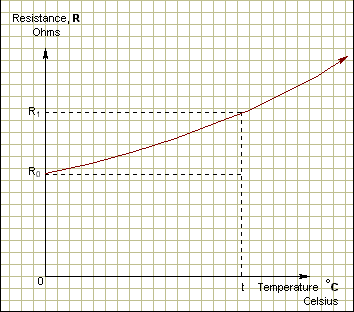 '''Graph showing how resistance varies with temperature''' The resistance of a conductor at a temperature, t, is given by the equation: R'_t_' = R'_0_'(1 + αt + βt2 + γt3....) where α, β, γ, etc., are constants and R'_0_' is the temperature at 0°C. The coefficients, β, γ, etc., are quite small and since we are normally only dealing with a relatively restricted temperature range (e.g., 0°C to 100°C) we can usually approximate the characteristic to a straight line law in which case, the equation simplifies to: R'_t_' = R'_0_'(1 + αt) where α is known as the temperature coefficient of resistance. Some typical values for α for various materials are given in the table below. Note that α is expressed in Ω/Ω/°C or just °C.
(:nl:)(:table style="clear:both":)
| |
(:Summary: Website page footer:)
Print - (:comment (:if group Site,SiteAdmin,Cookbook,Profiles,PmWiki*:) (:comment delete if and ifend to enable backlinks:) %item rel=nofollow class=backlinks accesskey='$[ak_backlinks]'% [[{*$Name}?action=search&q=link={*$FullName} | $[Backlinks] ]] (:ifend:) :) Search - Login
Page last modified on August 01, 2011, at 10:41 AM