
|
Introduction to Microcontroller Programming * Course Index * Introduction * About the Author * About this Course * Feedback * Course Navigation * Quick Course Navigation * How to use this Course * Acronyms Used and Course Conventions About PICmicro Chips * What is a PICmicro? * Microcontrollers * Digital versus Analogue * Inputs and Outputs * Memory * Programming * 16F1937 Architecture Clocking Your PICmicro Devices * Introduction * The Clock Circuit * Clock Settings * Clock Confusion E-Blocks * Introduction to E-blocks * Using E-blocks * E-blocks Boards Flowcode Step By Step * Introduction to Flowcode * Basic Flowcode Functions * Digital Outputs * Digital Inputs * Basic Loops * The LCD Display * Binary Numbers * Decisions * Goto (Connection Point) * 7-Segment Displays * Software Macro * Strings and Memory * A Simple Hi-Fi PICmicro Projects * Introduction to PICmicro Projects * Construction Methods * Choosing a Power Source * Adding Inputs * Input Conditioning * Adding Outputs * Adding Drivers ## Transistor Switch ## Darlington Driver ## 7-Segment Decoder Driver Labs * Introduction and Lesson Plan * 1. Output * 2. Delay * 3. Connection Point * 4. Calculations * 5. Loop * 6. Input * 7. Decision * 8. LCD * 9. Keypad * 10. Analogue + EEPROM * 11. Software Macro * 12. External Interrupt * 13. Timer Interrupt |
(:Summary:Contains the 'action' links (like Browse, Edit, History, etc.), placed at the top of the page, see site page actions:) (:comment This page can be somewhat complex to figure out the first time you see it. Its contents are documented at PmWiki.SitePageActions if you need help. :) * Print (:comment (:if group Site,SiteAdmin,Cookbook,Profiles,PmWiki*:) (:comment delete if and ifend to enable backlinks:) * %item rel=nofollow class=backlinks accesskey='$[ak_backlinks]'% [[{*$Name}?action=search&q=link={*$FullName} | $[Backlinks] ]] (:ifend:) :) * Login Darlington Driver<^< Transistor Switch | Course Index | 7-Segment Decoder Driver >^>(:nl:) Here is a problem! There are transistors that can handle large currents (and power). There are transistors with high current gains. But, no transistor does both. This table shows that!
One solution to the problem - use a darlington driver! This is a circuit invented by an American engineer, Dr. Sidney Darlington. It uses two transistors, so that the second transistor boosts the current, which has already been boosted by the first transistor. The circuit diagram for the darlington driver is given in the next diagram. 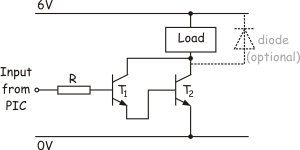 The current from the PICmicro chip is amplified by the first transistor, T1 and then by the second one, T2. If T1 has a current gain, hFE, of 200, and T2 has a current gain of 50, then the darlington pair has a current gain of 50 x 200 = 10 000. If the load were a motor, which takes a current of 5A (=5000mA), then the input would have to supply a current of only 0.5mA. Transistor T1 usually has a high current gain but does not need to handle much power. Transistor T2 is a power transistor, but does not need to have a high current gain. For example, T1 could be a BC108, and T2 a BFY51. You can buy darlington pair transistors purpose-made, with the two transistors housed in a single package. Examples are the BCX38B and the TIP120D. These have three legs, like a conventional transistor, and these are labeled collector, base and emitter. They are connected into the transistor switch circuit, shown earlier, as if they were a single transistor. The package may even contain the protective diode.  In reality, this labeling hides the fact that there are two transistors in the package. The next diagram shows the likely internal arrangement. 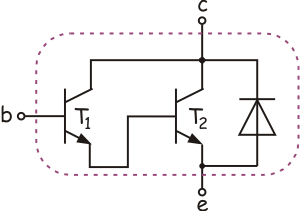 The hole in the metal backing plate of the TIP120 allows it to be bolted to a heat-sink. This increases the rate of cooling, allowing the device to handle even greater currents. A number of darlington drivers can be combined into one integrated circuit package, such as the ULN2003. The pin-out for this is shown next. Each darlington driver is represented by the symbol: 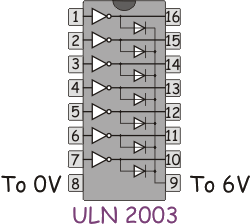 Notice that each darlington driver is protected by a diode. A package like this is useful when connecting a number of devices to the PICmicro chip output port. It can be used to develop enough current for a stepper motor when the sequence of signals is produced by the PICmicro program itself, rather than by a stepper driver chip. The next diagram shows part of a PICmicro circuit, with a stepper motor operated, through a ULN2003, by four bits of the output port, Port B. 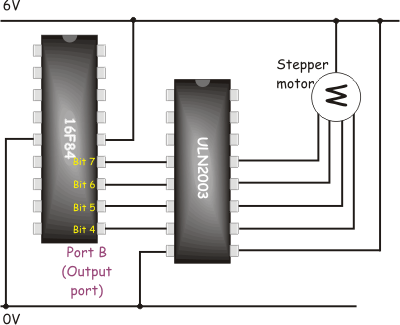 (:nl:)(:table style="clear:both":)
| |
(:Summary: Website page footer:)
Print - (:comment (:if group Site,SiteAdmin,Cookbook,Profiles,PmWiki*:) (:comment delete if and ifend to enable backlinks:) %item rel=nofollow class=backlinks accesskey='$[ak_backlinks]'% [[{*$Name}?action=search&q=link={*$FullName} | $[Backlinks] ]] (:ifend:) :) Search - Login
Page last modified on August 26, 2011, at 10:23 AM
