
|
Introduction to Microcontroller Programming * Course Index * Introduction * About the Author * About this Course * Feedback * Course Navigation * Quick Course Navigation * How to use this Course * Acronyms Used and Course Conventions About PICmicro Chips * What is a PICmicro? * Microcontrollers * Digital versus Analogue * Inputs and Outputs * Memory * Programming * 16F1937 Architecture Clocking Your PICmicro Devices * Introduction * The Clock Circuit * Clock Settings * Clock Confusion E-Blocks * Introduction to E-blocks * Using E-blocks * E-blocks Boards Flowcode Step By Step * Introduction to Flowcode * Basic Flowcode Functions * Digital Outputs * Digital Inputs * Basic Loops * The LCD Display * Binary Numbers * Decisions * Goto (Connection Point) * 7-Segment Displays * Software Macro * Strings and Memory * A Simple Hi-Fi PICmicro Projects * Introduction to PICmicro Projects * Construction Methods * Choosing a Power Source * Adding Inputs ## Switches ## Switch Unit ## Sensors ## Sensing Units * Input Conditioning * Adding Outputs * Adding Drivers Labs * Introduction and Lesson Plan * 1. Output * 2. Delay * 3. Connection Point * 4. Calculations * 5. Loop * 6. Input * 7. Decision * 8. LCD * 9. Keypad * 10. Analogue + EEPROM * 11. Software Macro * 12. External Interrupt * 13. Timer Interrupt |
(:Summary:Contains the 'action' links (like Browse, Edit, History, etc.), placed at the top of the page, see site page actions:) (:comment This page can be somewhat complex to figure out the first time you see it. Its contents are documented at PmWiki.SitePageActions if you need help. :) * Print (:comment (:if group Site,SiteAdmin,Cookbook,Profiles,PmWiki*:) (:comment delete if and ifend to enable backlinks:) * %item rel=nofollow class=backlinks accesskey='$[ak_backlinks]'% [[{*$Name}?action=search&q=link={*$FullName} | $[Backlinks] ]] (:ifend:) :) * Login Sensing Units<^< Sensors | Course Index | Input Conditioning >^>(:nl:) We have just seen that some sensors, like the thermistor and the LDR, produce a change in resistance when the conditions in the outside world change. We need to convert that change in resistance into a change in voltage or current in order for the electronic control system to understand it. The voltage divider is one way of doing that. It consists of two resistors connected in series (one after the other), so that they share the power supply voltage between them. 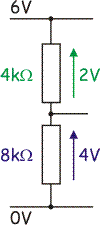 The diagram shows a voltage divider where one resistor is twice as big as the other. They share the 6V power supply voltage between them in such a way that the 8kW resistor takes twice as much of the voltage as the 4k ohm resistor. The sum of the voltages must equal the power supply's 6V, of course. Suppose that the lower resistor is actually a thermistor. Hence the different symbol, the rectangle with the hockey stick through it, in the next diagram. 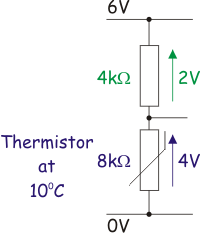 As luck would have it, the resistance of the thermistor is 8kW when its temperature is 100C! This means that the voltage across it will be 4V, as before. Let's suppose that it is a ntc thermistor, and that its resistance drops to 2kW when the temperature has risen to 500C. 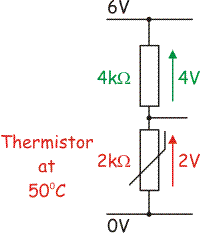 The voltage across the thermistor has now dropped to 2V. The thermistor resistance is now only half as big as the 4k ohm resistor, and so the voltage across the thermistor is only half that across the 4kW resistor. In other words, here we have a circuit that outputs a voltage that changes with temperature. Just what the control system needs to tell it what the weather is like in the outside world! Here are some more sensing units: 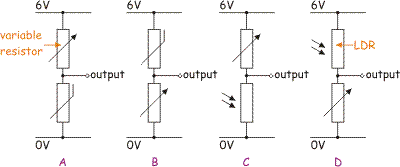 Sensing unit Behaviour # Temperature Output voltage drops as temp rises # Temperature Output voltage rises as temp rises # Light Output voltage drops as light level rises # Light Output voltage rises as light level rises Notice: * the symbol for a LDR * the fixed resistor in the earlier circuits has been replaced with a variable resistor (the symbol with an arrow through.) (:nl:)(:table style="clear:both":)
| |
(:Summary: Website page footer:)
Print - (:comment (:if group Site,SiteAdmin,Cookbook,Profiles,PmWiki*:) (:comment delete if and ifend to enable backlinks:) %item rel=nofollow class=backlinks accesskey='$[ak_backlinks]'% [[{*$Name}?action=search&q=link={*$FullName} | $[Backlinks] ]] (:ifend:) :) Search - Login
Page last modified on January 30, 2012, at 03:18 PM