
|
Introduction to Microcontroller Programming * Course Index * Introduction * About the Author * About this Course * Feedback * Course Navigation * Quick Course Navigation * How to use this Course * Acronyms Used and Course Conventions About PICmicro Chips * What is a PICmicro? * Microcontrollers * Digital versus Analogue * Inputs and Outputs * Memory * Programming * 16F1937 Architecture Clocking Your PICmicro Devices * Introduction * The Clock Circuit * Clock Settings * Clock Confusion E-Blocks * Introduction to E-blocks * Using E-blocks * E-blocks Boards Flowcode Step By Step * Introduction to Flowcode * Basic Flowcode Functions * Digital Outputs * Digital Inputs * Basic Loops * The LCD Display * Binary Numbers * Decisions * Goto (Connection Point) * 7-Segment Displays * Software Macro * Strings and Memory * A Simple Hi-Fi PICmicro Projects * Introduction to PICmicro Projects * Construction Methods * Choosing a Power Source ## Choosing a Power Source ## Batteries ## Primary Batteries ## Rechargeable Batteries ## Mains Power Supply Units * Adding Inputs * Input Conditioning * Adding Outputs * Adding Drivers Labs * Introduction and Lesson Plan * 1. Output * 2. Delay * 3. Connection Point * 4. Calculations * 5. Loop * 6. Input * 7. Decision * 8. LCD * 9. Keypad * 10. Analogue + EEPROM * 11. Software Macro * 12. External Interrupt * 13. Timer Interrupt |
(:Summary:Contains the 'action' links (like Browse, Edit, History, etc.), placed at the top of the page, see site page actions:) (:comment This page can be somewhat complex to figure out the first time you see it. Its contents are documented at PmWiki.SitePageActions if you need help. :) * Print (:comment (:if group Site,SiteAdmin,Cookbook,Profiles,PmWiki*:) (:comment delete if and ifend to enable backlinks:) * %item rel=nofollow class=backlinks accesskey='$[ak_backlinks]'% [[{*$Name}?action=search&q=link={*$FullName} | $[Backlinks] ]] (:ifend:) :) * Login Mains Power Supply Units<^< Rechargeable Batteries | Course Index | Adding Inputs >^>(:nl:) These come in all shapes, sizes and prices, from the battery eliminator, formed around a 13A mains plug, selling at a few pounds, to the sophisticated bench power supply unit, costing several hundred pounds. Power supply jargon:Mains power supply units convert the a.c. (alternating current) high voltage mains electricity supply into a low voltage d.c. (direct current) supply. The following diagrams show the difference between these. 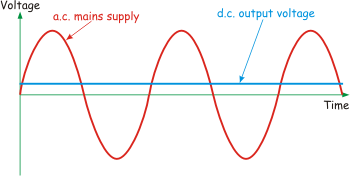 These signals are not drawn to scale. The mains electricity supply in the UK peaks at around 340 volts, whereas we are looking at d.c. power supplies delivering around 6 volts. When choosing a mains power supply unit, you need to consider: * the d.c. output voltage you require * the maximum current the power supply will have to deliver In addition, there are other factors: Problem 1:The d.c. output voltage may still contain a small a.c. fluctuation, known as a 'ripple voltage'. This is removed by a process called 'smoothing'. The factor 'ripple rejection' in the power supply specification measures the effectiveness of the smoothing. Problem 2:The mains electricity supply voltage fluctuates in the course of the day, depending on, what time of day it is, what the weather is like, and what is on the television. Simple d.c. power supplies pass this variation on in the output voltage. If the mains voltage fluctuates by 10%, then the d.c output voltage varies by 10%. A good power supply offers 'line regulation' - making the output voltage independent of variations in the a.c. mains supply voltage. Problem 3:We observed earlier that the voltage provided by a battery usually drops when it is supplying a high current. A similar tendency is seen in mains power supply units. Additional circuitry in the power supply can reduce this. This process is called 'load regulation', or sometimes 'stabilisation'. Typical performance:A typical mains power supply unit has the following performance figures: Ripple voltage - 10mV Line regulation - 0.1% Load regulation - 0.1% Ripple voltage - 10mV This means that on top of the steady dc output voltage, there could be a tiny ac voltage, 10mV high. 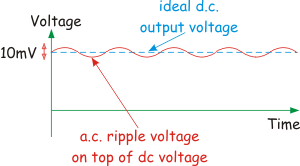 Line regulation - 0.1% The output voltage changes by 0.01V when the ac input voltage changes by 10V. Load regulation - 0.1% In switching from maximum output current to no output current, the output voltage changes by only 0.1% (:nl:)(:table style="clear:both":)
| |
(:Summary: Website page footer:)
Print - (:comment (:if group Site,SiteAdmin,Cookbook,Profiles,PmWiki*:) (:comment delete if and ifend to enable backlinks:) %item rel=nofollow class=backlinks accesskey='$[ak_backlinks]'% [[{*$Name}?action=search&q=link={*$FullName} | $[Backlinks] ]] (:ifend:) :) Search - Login
Page last modified on August 26, 2011, at 09:33 AM