
|
Introduction to Microcontroller Programming * Course Index * Introduction * About the Author * About this Course * Feedback * Course Navigation * Quick Course Navigation * How to use this Course * Acronyms Used and Course Conventions About PICmicro Chips * What is a PICmicro? * Microcontrollers * Digital versus Analogue * Inputs and Outputs * Memory * Programming * 16F1937 Architecture Clocking Your PICmicro Devices * Introduction * The Clock Circuit * Clock Settings * Clock Confusion E-Blocks * Introduction to E-blocks * Using E-blocks * E-blocks Boards Flowcode Step By Step * Introduction to Flowcode * Basic Flowcode Functions * Digital Outputs * Digital Inputs * Basic Loops * The LCD Display * Binary Numbers * Decisions * Goto (Connection Point) * 7-Segment Displays * Software Macro * Strings and Memory * A Simple Hi-Fi PICmicro Projects * Introduction to PICmicro Projects * Construction Methods * Choosing a Power Source * Adding Inputs * Input Conditioning * Adding Outputs ## LED's ## Using LED's ## 7seg Displays ## LCD Displays ## Using LCD Displays ## Buzzers / Sounders ## Motors ## Stepper Motors ## Solenoids * Adding Drivers Labs * Introduction and Lesson Plan * 1. Output * 2. Delay * 3. Connection Point * 4. Calculations * 5. Loop * 6. Input * 7. Decision * 8. LCD * 9. Keypad * 10. Analogue + EEPROM * 11. Software Macro * 12. External Interrupt * 13. Timer Interrupt |
(:Summary:Contains the 'action' links (like Browse, Edit, History, etc.), placed at the top of the page, see site page actions:) (:comment This page can be somewhat complex to figure out the first time you see it. Its contents are documented at PmWiki.SitePageActions if you need help. :) * Print (:comment (:if group Site,SiteAdmin,Cookbook,Profiles,PmWiki*:) (:comment delete if and ifend to enable backlinks:) * %item rel=nofollow class=backlinks accesskey='$[ak_backlinks]'% [[{*$Name}?action=search&q=link={*$FullName} | $[Backlinks] ]] (:ifend:) :) * Login Motors<^< Buzzers / Sounders | Course Index | Stepper Motors >^>(:nl:) A wide range of motors is available, differing mainly in their power rating. The higher the power rating, the greater the load that the motor can move. However, the greater the power rating, the higher the current that the motor needs to operate. 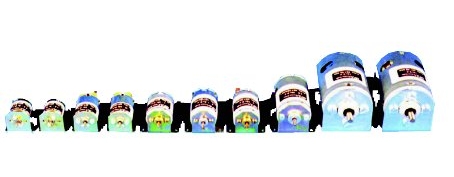 The main problem in using PICmicro chips to control motors is the large current that motors demand. In the vast majority of cases, this current has to be supplied by a driver circuit placed between the PICmicro chip and the motor. We deal with this topic later. Motors are electromagnetic devices, and that gives rise to another potential problem. When an electric current flows through the coil in the motor, it produces a magnetic field. This magnetic field causes the motor to rotate. However, when the current is switched off, the magnetic field collapses, and in the process generates a very high voltage in the coil of wire. The energy that was stored in the magnetic field is converted into electricity. The voltage produced can be so high that it damages electronic components connected to the motor. This danger can be avoided by connecting a diode in parallel with the motor, as shown in the circuit diagram. 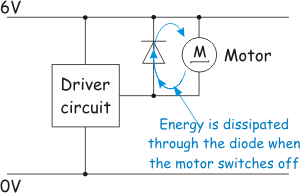 Under normal conditions, the diode does nothing. It is reverse-biased, (connected the wrong way round to pass an electric current.) On the other hand, when the motor is switched off, the voltage generated as the magnetic field collapses causes a current to flow through the diode. The energy is dissipated as heat in the diode, and causes no harm to the driver circuit. (:nl:)(:table style="clear:both":)
| |
(:Summary: Website page footer:)
Print - (:comment (:if group Site,SiteAdmin,Cookbook,Profiles,PmWiki*:) (:comment delete if and ifend to enable backlinks:) %item rel=nofollow class=backlinks accesskey='$[ak_backlinks]'% [[{*$Name}?action=search&q=link={*$FullName} | $[Backlinks] ]] (:ifend:) :) Search - Login
Page last modified on August 26, 2011, at 10:12 AM